

Table of Contents
In a nail salon, a turn is one guest counted toward a technician's total for the day, and the next walk-in usually goes to the available technician with the fewest turns, with ties going to whoever signed in first. Each salon decides what a service is worth: a full set is typically one full turn, a polish change half a turn, and a free repair no turn at all.
There is no single standard, so this guide goes through the decisions every salon has to make and shows what each one does to the order on a busy morning.
We make nail salon software, including a turn board. Everything here except the last section works on paper too.
How does the turn list work?
Technicians go on the list as they sign in, which is why many salons call it first come, first served. When a guest comes in without asking for anyone, the front desk looks only at technicians who are signed in, free and not on break, and gives the guest to the one with the fewest turns.
On paper this often looks like a line: the name at the top takes a guest and moves to the bottom. Counting turns gives much the same order on an ordinary run. The two part ways when something unusual happens. A line can't remember that someone was at lunch, only did a polish change, or came in late. A count can, because the number is still there when they come back. That's why this guide uses a count.
One morning, step by step
Here is a made-up morning at a salon with four technicians. The salon's rules:
- A gel manicure, pedicure, full set or fill is one turn. A polish change is half a turn. A free fix on your own work is no turn.
- The list sorts by whole turns, so a half doesn't move anyone down until a second half makes a whole.
- A tie goes to whoever signed in first.
- Signing in after 10:00 starts you with one turn.
- A booked guest who asks for someone counts as half a turn.
- A turn counts as soon as the guest is assigned.
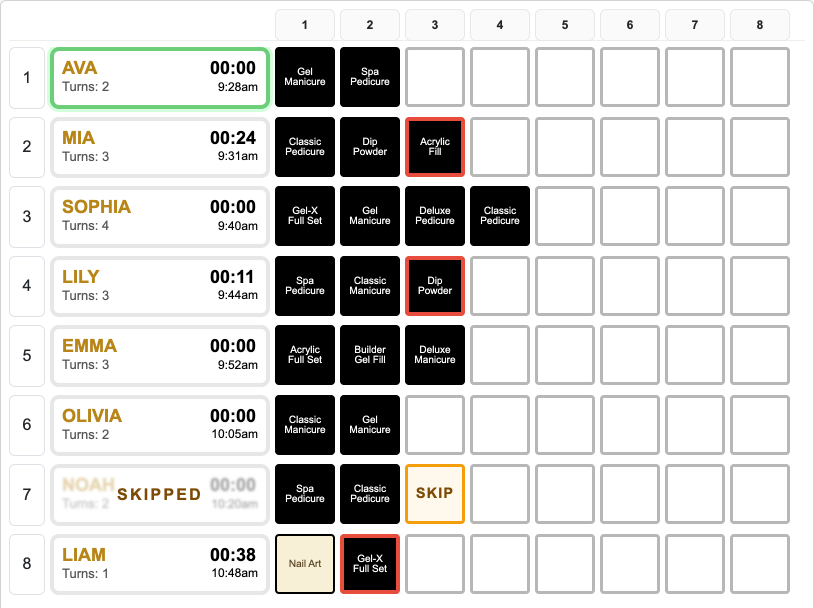
Ava signed in at 9:10, Olivia at 9:15 and Emma at 9:25. Sophia is running late. Each row is one technician's morning, in order.
The moments that matter:
- Ties. At 9:35, 10:25 and 11:15 the counts were level, so the guest went to whoever signed in first.
- 9:45 and 10:10. Olivia's polish change counts half. The half doesn't cost Olivia their place, so Olivia still takes the 10:10 full set.
- 10:20. Sophia signs in after the 10:00 cutoff, so Sophia starts with one turn.
- 10:30. A booked guest asks for Sophia. A request goes to the person asked for, and counts half here.
- 10:50. Emma goes on break until 11:10. Emma's count stays at 1.
- 11:20. Emma is next but doesn't do acrylic at this salon, so the fill goes to Sophia. Emma stays next.
- 11:30. Emma's 10:00 guest returns with a chipped toenail. A free fix on Emma's own work is no turn.
At noon the counts look uneven, and the list is already evening them out: Emma is next, then Olivia, and Ava stays at the bottom until the others catch up.
What counts as a turn?
A simple way to start is to sort your menu into three groups. This is one example, not a standard:
- Full turn (1): full set, fill, pedicure, gel manicure, dip. A real block of the technician's time.
- Half turn (0.5): polish change, paraffin. A quick job. Nobody should lose their place for taking it.
- No turn (0): a free fix on your own work, nail art or French tip added during a service. No new guest.
Settle the in-between services first, such as a basic manicure, because those are the ones people argue about. You can set the value service by service, or draw a price line, where anything under a set price counts half. A service list is easier to explain. A price line needs no upkeep when you add a service, but raising a price can quietly change what counts.
Four more things to settle at the same time:
- How a half counts. Some salons let a half wait, so 1.5 sits level with 1 until a second half makes 2. Others read the number as written, so 1 goes ahead of 1.5. The first protects whoever took the quick job. The second is easier to read off a sheet. The morning above uses the first.
- Several services on one guest. One technician doing a manicure and a pedicure on one guest can count as two turns, or be capped at one. A cap stops one big ticket from dropping someone down the list twice.
- Two technicians on one guest. If one does the hands and another does the feet, each counts their own part.
- When the turn counts. Either when the guest is assigned or when the ticket closes. A technician with a guest is off the list either way, so the order barely changes. The difference is in fixing mistakes. Counting at the close matches what was really done if the guest changes or adds a service. Counting at assignment shows the number right away, but someone has to clear the turn if the guest leaves before the service starts. Write down who can do that.
Who goes first when turns are tied?
The usual answer is whoever signed in first. It rewards coming in early, and it also means the earliest person wins every tie that day, so make sure the whole team knows that's the rule. In the morning above, it decides the 9:35, 9:45, 10:25 and 11:15 guests.
What happens with skips, breaks and late arrivals?
A skip isn't one thing, so give each kind its own answer.
- Can't do the service. The guest goes to the next technician who can. The skipped technician didn't use a turn, so they stay next, like Emma at 11:20.
- A booked guest is due soon. If the service won't finish in time, pass them this once. Their count doesn't change, so they stay at the top.
- Chose to pass. Decide this one ahead of time. Some salons treat a pass as a used turn, so nobody waits out the small tickets for the big ones. Others let it go.
- Breaks. Take the technician off the list while they're out, and leave the count alone. Because the order comes from the count, they come back where the numbers put them, which can be ahead of people who took guests in the meantime. That's fair for ten minutes. If it feels wrong for a long lunch on a busy day, write down how long a break can run before it costs something.
- Late arrivals. With a count, someone who signs in at noon with no turns sits ahead of everyone on 3 and takes the next few walk-ins. One fix is to start them with some turns already counted, as the morning above does with one. Pick a number that suits your hours.
Do requested technicians count as a turn?
A guest who asks for someone goes to that person, whoever is next. The list doesn't decide this one. The only question is what it does to the count, and there are three usual answers:
- A full turn. Keeps the count simple. A technician with many regulars gets fewer walk-ins.
- Half a turn. A middle ground. One request doesn't cost their place, and two make a turn.
- No turn. Rewards building a following. That technician can see many more guests in a day than the others.
If the requested technician is busy, the guest chooses: wait for them, or take whoever is next. If they wait, the list keeps moving for everyone else. Decide too whether a walk-in who asks for someone by name follows the same rule as a booked request. It's simpler if it does.
Do appointments count as a turn?
Salons answer this in a few ways. Some count an appointment like any other guest. Some don't count it, and the list only shares out walk-ins. Some treat only the guests who asked for a particular technician differently. A booking that doesn't name anyone can simply be treated as a walk-in: it goes to whoever is next when the guest arrives.
If a booking counts, count it when the guest arrives, not when they book, so a no-show costs nobody a turn. Then leave room for the book. Before giving a long service to the next technician, check when their next booked guest is due. A full set started at 2:15 won't be done before a 3:00 appointment.
How do you move off a paper list?
A paper list works while one person can keep it straight, and a small salon may never need more. It starts to slip when half turns need adding up, when the person holding the list is also answering the phone, and when technicians can't see it. If you're moving to a screen:
- Write the rules down first. A screen won't settle an argument your rules don't answer. The sheet below is a place to start.
- Give every service a value. Go through the menu once, including the services you only do now and then.
- Start on a slow day. Keep the paper next to the screen for a day or two. If they disagree, find out why before the weekend.
- Name who can change a turn. Mistakes happen. One or two people fixing them in the open beats everyone fixing them quietly.
- Put the order where the team can see it. The argument is usually about whether anyone can check the count.
- Leave the rules alone for a few weeks. Give them time before you change anything.
A rule sheet to start from
This is a starting point, not a standard. Change what doesn't fit, then post it where everyone can read it.
| Who is next | Fewest whole turns among technicians who are free |
| Tie | Whoever signed in first |
| Full turn | Full set, fill, pedicure, gel manicure, dip |
| Half turn | Polish change, paraffin |
| No turn | A free fix on your own work, nail art or French tip added during a service |
| Request | Half a turn |
| Booking with no request | Same as a walk-in |
| Several services, one technician | One turn at most |
| Two technicians, one guest | Each counts their own part |
| Can't do the service | Passed over, stays next |
| Break | Off the list, count unchanged |
| Late sign-in | Starts with one turn after your cutoff |
| When it counts | When the guest is assigned |
| Who can change a turn | One or two named people |
How Aura handles this
Aura's Turn Manager keeps the count described here. With the same service values and cutoff as the morning above, its list gives the same order at every step.
- Who is next. The available list shows technicians who aren't with a guest or on skip, by whole turns, fewest first. A tie goes to whoever is higher on the board, which is sign-in order.
- What counts. Each service has its own value in half steps, including zero, and a second value for requests. A new service starts at 1 and 0.5. Aura uses the second value when a guest booked and asked for that technician, and the Request button on the ticket lets the front desk turn it on or off.
- Breaks and late arrivals. Skip takes a technician off the list and leaves the count alone. Late Turn, if you set a cutoff, adds one counted turn at sign-in, and Sundays can have their own time. It adds one turn only, so a very late arrival can still sit near the top.
- Service fit and bookings. The list can be filtered by service category, and Aura warns before assigning a service a technician isn't set up for. A technician's next requested appointment shows beside their name, and Aura asks before a walk-in is assigned over it. The front desk decides.
- When it counts. In Manual mode, the count changes when the front desk puts a service on the board or marks a guest's cell Done. In Automatic mode, it changes when the ticket closes at checkout, and Turn Max limits what one technician's part of a ticket can add (1 by default, 0.5 for requests).
- Who can see and change it. The board updates on connected screens, and technicians can check their place on the Staff App. Reset Turns clears the counts, and Start Over clears the board and waiting list so the new day's order comes from sign-in. Clearing a turn, Reset Turns and Start Over ask for the admin password unless the salon turns that off.
- Plans. The Turn Manager is on every plan. Automatic turns, Smart Checkout and the Staff App start at Professional.
FAQ
What is a turn in a nail salon?
A turn is one guest counted toward a technician's total for the day. The next walk-in usually goes to the available technician with the fewest turns.
Who gets the walk-in when turns are tied?
Usually whoever signed in first. Make sure the whole team knows that's the rule, because the earliest person wins every tie that day.
Does a polish change count as a full turn?
Often not. Many salons count a polish change as half a turn, so nobody loses their place for taking a quick job. Each salon sets its own values.
What happens to a technician's turns during a break?
Take the technician off the list while they're out and leave the count alone. They come back where the numbers put them.
Should a no-show appointment count as a turn?
No. If bookings count at all, count them when the guest arrives, not when they book, so a no-show costs nobody a turn.
Can a salon run turns on paper?
Yes. A paper list works while one person can keep it straight. It starts to slip when half turns need adding up and technicians can't see the list.
If something here doesn't match how your salon works, tell us at support@aura-pos.com.